


Warrington Driving Test Centre: Routes, Pass Rate and Test-Day Guide

Test booked at Warrington driving test centre? Take a breath. It is completely normal for you to feel nervous before you have been there. You might be wondering where to park, which roads could come up, whether the roundabouts are difficult, or what happens if the sat nav sends you somewhere unfamiliar.
The reassuring bit is that you do not need to know Warrington by heart. Your examiner is not looking for a perfect local tour guide. They want to see that you can read the road, make safe decisions and stay in control when the route changes. This guide will help you get familiar with the centre, the latest pass-rate and waiting-time figures, the road types worth practising and what to expect from the moment you arrive.
If you would like structured local preparation, Asia Driving School offers driving lessons in Warrington, subject to instructor and postcode availability.
Warrington driving test centre at a glance
Address: Warrington Borough Council, Orford Day Centre, Festival Avenue, Warrington, Cheshire, WA2 9EP
Main test type: Practical car tests. Some third-party listings also show ADI Part 3; confirm current test types through GOV.UK.
Parking: Candidate parking is commonly reported at the centre. Follow the marked customer bays and your booking instructions.
Toilets: Male and female toilets are commonly reported. Accessibility details conflict across third-party guides, so confirm any adjustment before test day.
Latest full-year car pass rate: 55.5% in 2025/26: 4,193 passes from 7,550 tests
Latest published median wait: 10.6 weeks in July 2026; availability changes continually
Standard driving time: Around 35 minutes
DVSA enquiries: 0300 200 1122 - this is the general DVSA line, not a direct centre number
Where is Warrington driving test centre?
You will find the centre at Orford Day Centre on Festival Avenue, north of Warrington town centre. Put the full postcode WA2 9EP into your sat nav and compare it with the address in your booking email. Do not search for a theory test centre by mistake; practical and theory tests are held separately.
By car, the centre is reached from the local Orford road network, with the A49, A50 and A57 providing the main connections from different parts of Warrington. The journey can be straightforward, but traffic around major junctions and school or commuter times can add delays. Check live traffic and roadworks before leaving.
Coming by public transport? Warrington Central railway station and Warrington Interchange are useful central arrival points, but you will still need a local bus, taxi or lift to Festival Avenue. Timetables and routes can change, so plan the complete journey using a live travel planner rather than relying on an old test-centre guide.
It can also help to look at the approach on Google Street View a few days beforehand. That is not route memorisation; it simply stops the entrance and parking layout from being one more surprise on the day.

Getting familiar with the entrance and parking arrangements can make test day feel much calmer.
How early should you arrive driving test centre ?
Aim to arrive around 15 minutes before the appointment unless your booking tells you something different. Leave enough journey time for traffic, but avoid turning up very early and repeatedly driving around the centre entrance. Once you arrive, use a marked customer bay, secure the car and wait where instructed. The car park is part of a working test centre, so it is not the place for last-minute manoeuvre practice.
What is the Warrington driving test centre pass rate?
The latest complete DVSA figures show a Warrington driving test centre pass rate of 55.5% for 2025/26. During that year, 7,550 car tests were taken and 4,193 candidates passed. Across Great Britain, the comparable pass rate was 50.0%.
For automatic tests at Warrington, the 2025/26 pass rate was 48.6%, based on 976 passes from 2,010 tests. That difference does not mean an automatic test is harder. Automatic candidates, test readiness and local booking patterns can all affect the result.
2025/26: 55.5%
2024/25: 55.3%
2023/24: 53.1%
2022/23: 53.1%
2021/22: 57.3%
2020/21: 61.8% (pandemic-affected year with lower test volumes)
Source: DVSA car driving-test data, updated through March 2026.
It is an encouraging figure, but please do not let it get into your head. A centre pass rate cannot predict your result, and it does not make Warrington an “easy” test centre. Examiners use the same national standard. A much better question is: can you complete an unfamiliar 35-minute drive safely without your instructor stepping in?
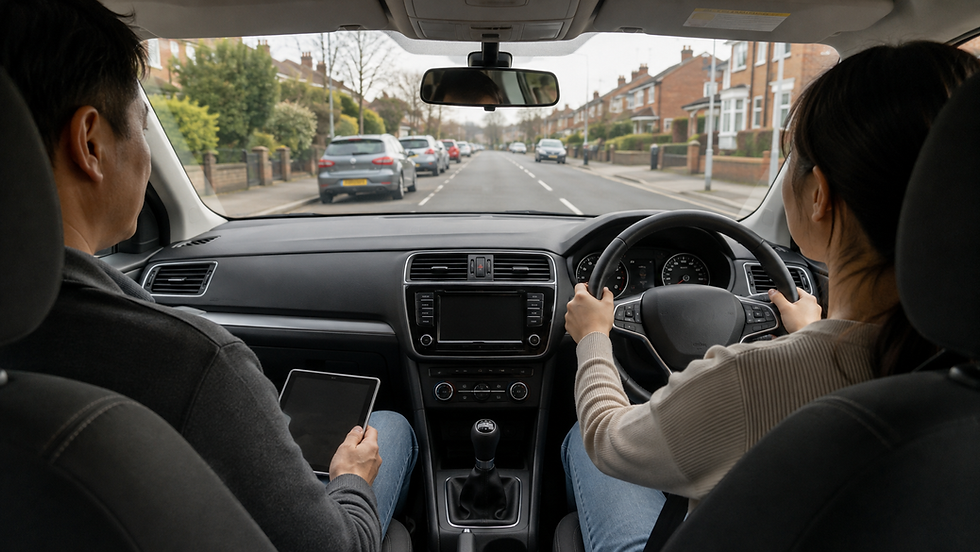
Pass rates are useful context, but your preparation matters far more than the centre average.
Are Warrington driving test routes published?
No. The DVSA does not publish official car-test routes. You will find videos, maps and downloadable Warrington driving test routes online, but they can only show possible practice roads. They cannot promise the route, direction, traffic conditions or roadworks you will meet.
That matters because memorising turns can create false confidence. You might know that one familiar roundabout needs the right-hand lane, then panic when the examiner names a different exit. Prepare for the decision, not the script: read the signs, use the correct lane, check your mirrors and take the safe option if you miss a turn.
During independent driving, the examiner may ask you to follow a sat nav, traffic signs or both. The examiner sets up the sat nav. If you take a wrong turning safely, you are not given a fault simply for going the wrong way; they will help you get back on route.

Use local routes to build adaptable skills, not to memorise a sequence of turns.
Which Warrington roads and driving conditions should you practise?
The area around Orford gives examiners access to a useful mix of quieter streets, busy A roads, roundabouts, changing speed limits and multi-lane junctions. You may not use every road below, but if you can handle these situations calmly, you will be better prepared for whatever appears.
Festival Avenue and the first few minutes
Nerves are usually highest when you first move away. Around Festival Avenue, focus on a clean start: effective observations, a safe gap, good clearance from parked cars and early planning at the end of the road. The same applies when you return—do not relax too early just because the centre is in sight.
A49 Winwick Road, A50 Long Lane and faster connections
These roads are useful for practising lane choice, joining traffic, reading signs early and responding to speed-limit changes. Keep your speed appropriate to the conditions; driving well below the limit without a reason can hold up traffic, while accelerating just because the limit rises can leave you too fast for the next junction.
A57 junctions and larger roundabouts
Competitor guides regularly mention the A57 roundabout and Warrington’s larger or double-roundabout layouts. The key is not to rush. Identify the exit, read the road markings, choose your lane early and use mirrors before changing position. If you end up in the wrong lane, follow it safely rather than swerving across.
Orford Green, Orford Road and nearby residential streets
Residential areas around Orford, Longford and Padgate can involve parked cars, narrow gaps, pedestrians, cyclists and limited views at junctions. Practise meeting oncoming vehicles without squeezing through, choosing sensible passing places and reducing speed before a hazard—not halfway through it.
Padgate Lane, Blackbrook Avenue and mini-roundabouts
Mini-roundabouts can catch learners who treat them like ordinary crossroads. Slow down, look properly to the right, signal when helpful and drive around the centre marking where space allows. On a sequence of junctions, reset your observations each time instead of assuming the next one is clear.
Birchwood Way and Woolston Grange Avenue
The wider Warrington network gives you a chance to practise faster dual-carriageway-style roads, larger junctions and earlier lane planning. Build the habit of checking signs well in advance. Sat nav instructions are helpful, but road signs and markings are the final authority.
Town-centre one-way systems, bus lanes and the Scotland Road bus gate
If your practice takes you towards the centre, watch carefully for one-way streets, bus-lane operating signs and restricted sections such as the Scotland Road bus gate. Do not follow the vehicle ahead blindly. Read the restriction yourself, check the times shown and choose a legal route.

The local skills that make the biggest difference
Look early at junctions. A quick late glance is not enough to judge approaching traffic properly.
Use mirrors before changing speed or position. That includes braking, changing lanes and moving around parked vehicles.
Make your lane decision early. A safe missed exit is better than a last-second correction.
Notice every speed-limit change. Check for signs after turns and when the road character changes.
Keep making progress when it is safe. Hesitation can become a problem when there is a clear opportunity to go.
Recover calmly. A stall, missed turn or small driving fault does not automatically end the test.
What happens during the practical test?
The test at Warrington follows the same current format as every other car driving test in Great Britain. The driving normally lasts around 35 minutes.
Eyesight check. You read a number plate from 20 metres for a current-style plate, or 20.5 metres for an older plate.
“Show me, tell me” questions. You answer one vehicle-safety question before driving and demonstrate another task while on the road.
General and independent driving. You follow examiner directions and complete around 20–35 minutes of independent driving using a sat nav, traffic signs or both.
Pulling over and one reversing exercise. You may parallel park, park in a bay, or pull up on the right and reverse. You may also be asked to perform an emergency stop.
How is the test marked?
There are three types of fault: a driving fault, a serious fault and a dangerous fault. You can pass with no more than 15 driving faults, provided you make no serious or dangerous faults. Repeating the same driving fault can become serious if it shows an unsafe pattern.
At the end, the examiner tells you the result and explains the faults they recorded. If you pass, you receive a pass certificate and can usually hand over your provisional licence so the full licence is sent automatically. You can drive straight away once you are properly insured to drive without supervision.
If you do not pass, it is disappointing—but it is not a verdict on you as a driver. Use the examiner’s feedback with your instructor and book a new test at least 10 working days later.
Warrington driving test waiting times and cancellations
Waiting times change constantly. The most recent published DVSA centre data available when this guide was prepared reported a median booking-to-test wait of 10.6 weeks at Warrington in July 2026. In the same release, 530 of 3,154 standard test appointments in the booking window were still available at the reporting point.
Those figures are a snapshot, not a promise. Appointments can appear when the DVSA releases new capacity or another learner changes their booking. Check through the official GOV.UK booking service.
The booking rules changed in 2026. Only the learner can change, cancel or swap their own test. Unofficial services are not allowed to scan the booking service for appointments, and using one can lead to access restrictions or a cancelled booking. You can make up to two changes; after that, you must cancel and book again.
When moving a booking, you are limited to the three centres nearest the centre currently attached to the booking, plus the centre you first booked during that booking. That means you cannot always jump to any centre in the country simply because it shows an earlier date.

Use the official GOV.UK service and make sure you—not an unofficial app—manage the booking.
How much does the test cost?
At the time of writing, a standard car test costs £62 on a weekday or £75 in the evening, at a weekend or on a bank holiday. If you change or cancel, give at least 10 full working days’ notice to protect the fee. Monday to Saturday count as working days; Sundays and public holidays do not.
Can you choose another nearby test centre?
Widnes and Northwich are commonly suggested as nearby Cheshire alternatives, while St Helens may also be practical for some Warrington learners. Do not choose a centre only because an old blog shows a higher pass rate. Think about travel, lesson time and whether you can practise the unfamiliar road types there.
Also remember the 2026 geographical change rule: the GOV.UK service decides which three nearby centres your booking can move to. Check the options shown for your specific booking before making a plan.
What should you take to Warrington driving test centre?
Keep this bit simple. Put everything together the night before so you are not searching the house for your licence five minutes before you need to leave.
Your UK driving licence. If you have an older paper licence, check the additional identification rules on GOV.UK.
Your theory-test pass certificate, if you still have it. You do not need a replacement if it is lost, because the result can be checked.
A suitable car. This is usually your instructor’s car, but you can use your own if it meets every DVSA requirement.
Any glasses or contact lenses you need for driving. You must pass the eyesight check.
Your booking details. Keep the test time, reference and centre instructions easy to find.
If you lose your photocard licence, apply for a replacement immediately. GOV.UK warns that a replacement can take up to 15 days, and your test may not go ahead without the required licence.
A five-minute check the night before can prevent a very stressful morning.
Using your own car
Your own car does not need dual controls, but it must be roadworthy, taxed, correctly insured for a driving test and have a valid MOT when required. It also needs legal tyres, no safety warning lights, L-plates at the front and rear, an extra interior mirror for the examiner, a suitable passenger seatbelt and head restraint, and an mph speedometer.
Tidy the cabin and keep it smoke-free. Insurance cameras may face outside but must not film or record audio inside the car. You cannot use self-parking, autopilot or your own sat nav during the test. Some vehicle models and recalled cars need extra checks or proof, so read the current GOV.UK own-car rules rather than relying on a general checklist.
A calm test-day plan
The night before: Check the booking, licence, car arrangements, weather, traffic and roadworks. Get normal rest instead of cramming in hours of late practice.
Before leaving: Eat something light, take your glasses if needed and leave enough time for the real traffic conditions.
On arrival: Use a marked customer bay, switch off the car and follow the centre instructions. Do not practise in the car park.
During the test: Listen to the full direction, read the road ahead and choose safety over rushing. Ask for a direction to be repeated if you did not hear it.
After a mistake: Keep driving. One small fault may still be only one small fault; replaying it in your head can cause the next problem.
At the end: Listen to the examiner’s feedback. If you pass, check your insurance before driving alone. If not, turn the fault report into a focused lesson plan.
How to prepare without overthinking it
The best final preparation is not driving the same loop until you can do it with your eyes closed. It is proving that your skills still work when the road, weather, traffic and directions change.
Complete at least one realistic mock test with normal instructor help removed.
Practise at different times of day so busy and quiet traffic both feel familiar.
Include residential streets, faster roads, mini-roundabouts, larger roundabouts and multi-lane junctions.
Follow the sat nav without staring at it; keep your main attention on the road.
Ask your instructor which faults are repeating, then fix the cause rather than the symptom.
Check the weather and current roadworks on the day, but do not panic if conditions are not perfect—the examiner expects you to adapt safely.
Prepare for your Warrington test with Asia Driving School
If Warrington still feels like a lot to take in, that is exactly what lessons are for. A good instructor will not teach you to perform a memorised route. They will help you become comfortable with the road types, independent decisions and pressure you are likely to face.
Asia Driving School supports learners with manual and automatic lessons, mock-test preparation and refresher support in Warrington, subject to instructor and postcode availability. Explore driving lessons in Warrington, ask about a mock test or refresher lesson, or view the current instructor list.
You do not need a flawless drive to pass. You need a safe, independent one. Prepare broadly, arrive with time to spare, and take the test one decision at a time.
Frequently asked questions
Where is Warrington driving test centre?
It is at Warrington Borough Council, Orford Day Centre, Festival Avenue, Warrington, Cheshire, WA2 9EP. Check the address in your booking confirmation before travelling.
What is the Warrington driving test centre pass rate?
The official 2025/26 car pass rate was 55.5%, based on 4,193 passes from 7,550 tests. It is useful context, not a prediction of your own result.
Is Warrington an easy driving test centre?
No test centre is automatically easy. Warrington’s recent pass rate is above the Great Britain average, but examiners use the same national standard and your preparation matters more than the centre figure.
Are Warrington driving test routes available online?
The DVSA does not publish official routes. Unofficial maps and videos can introduce local roads, but the route used on your test can be different. Practise varied road types instead of memorising turns.
How long is the practical driving test at Warrington?
A standard car test includes around 35 minutes of driving. The independent-driving section normally lasts around 20–35 minutes.
What happens if I take a wrong turn?
A safe wrong turn is not automatically a fault. Continue safely and let the examiner redirect you. An unsafe reaction such as a sudden lane change can still be assessed.
Does the test include motorway driving?
No. Motorways are not used in the practical car test, although faster A roads and dual-carriageway-style roads can form part of the drive.
Does Warrington driving test centre have parking and toilets?
Candidate parking and male and female toilets are commonly reported. Check your booking instructions and the official centre finder for current facilities.
Is there disabled access at Warrington driving test centre?
Third-party listings conflict on the access details. Tell DVSA about your needs when booking and confirm the current arrangements before test day.
What is the direct phone number for Warrington test centre?
There is no public direct centre number. For general DVSA driving-test enquiries, call 0300 200 1122. Use the details in your booking confirmation for a booking-specific query.
Can I use my own car for the test?
Yes, if it meets every DVSA rule, including roadworthiness, tax, test insurance, legal tyres, L-plates, an examiner mirror and the required passenger safety equipment.
How soon can I rebook after failing?
You can book again, but the new date must be at least 10 working days after the failed test. Use the examiner’s feedback to target your next lessons.


Comments