


Roundabout Lanes Explained: How to Choose Your Lane and Exit Safely

Your sat nav says, “Take the second exit.” You see two approach lanes, a road sign and an arrow painted just before the give-way line. Which one should you follow?
The answer is the sign and road markings for that particular roundabout. Decide which exit you need, read any destination names and lane arrows, then move into the appropriate lane in good time. The usual left-for-left and right-for-right pattern helps when the layout is simple, but it does not override the instructions on the road. That is the key to understanding roundabout lanes. The Highway Code, Rules 184–186, sets out the approach, priority, position and signals.
If you keep asking which lane to be in on a roundabout, use this order: your exit → direction sign → lane markings → safe position and signal. Work it out while you still have time to change lanes safely. Never make a sudden move across another lane because you spotted an arrow late.

The quick guide: left, intermediate or right?
The table describes the general approach unless signs or road markings tell you otherwise. It does not replace reading the junction in front of you.
Where you are going | Usual approach lane | Signal on approach | Before leaving |
First exit to the left | Left | Left | Keep left and continue the left signal |
An intermediate exit, often straight ahead | The appropriate lane for the signs, markings and layout | Normally no signal | After passing the exit before yours, check mirrors and signal left |
An exit to the right or a full circle | Right | Right | After passing the exit before yours, check mirrors and signal left when preparing to leave safely |
The important word is appropriate. The Highway Code rules on roundabouts do not say that every second exit uses the left lane, or that every third exit uses the right. An exit number is not the same as its direction on the sign. Check the actual route and arrows.
How do you choose a lane before reaching the roundabout?
Imagine you are driving towards an unfamiliar junction and need the town-centre exit. Try this short routine:
Find your destination on the advance sign. It may show the road number or town name, not just an exit number.
Read the lane arrows and words on the approach. An arrow or destination marking may assign your route to a lane you did not expect.
Check mirrors before positioning. Make a safe, early lane change if needed; do not cross a solid line or force another driver to brake.
Slow enough to observe. Look towards circulating traffic on your right, then check ahead again before moving off. Give priority to traffic from the right unless signs, markings or traffic lights direct otherwise.
Keep looking after you enter. Follow your lane and prepare your left signal after passing the exit before yours.
This routine answers which lane to be in on a roundabout more reliably than counting exits at the last moment. Rule 184 asks drivers to act on signs, lights and markings, decide on the exit early and adjust speed and position to the traffic around them. Rule 185 also warns that other road users may signal incorrectly or not at all.
A simple exception that catches learners out
You want to go straight ahead, but the left approach lane has a left-turn-only arrow. Take the lane that the markings assign to straight ahead. Do not stay left simply because someone taught you that “straight ahead always means left lane”. The arrows change the decision.
What are the two-lane roundabout rules in the UK?
Two approach lanes do not mean there are only two exits. One lane may serve several exits, and the second or third exit could be left, ahead or right depending on where the roads join. Start by finding where your destination lies, not by assigning a lane to its exit number. Rule 186 gives the usual left-lane approach for the first exit to the left, right-lane approach for an exit to the right or a full circle, and the appropriate lane for an intermediate exit, unless signs or markings indicate otherwise.
Imagine this illustrative five-exit roundabout with two lanes on your approach and no special lane arrows. You enter at six o’clock:
Exit in this example | Position relative to your approach | Lane to consider before checking the junction |
First | Left, around eight o’clock | Left lane |
Second | Left of straight ahead, around ten o’clock | Often left, but treat it as an intermediate exit and check the layout |
Third | Straight ahead, around twelve o’clock | Often left on a simple layout, but use the appropriate lane for this junction |
Fourth | Right, around two o’clock | Right lane |
Fifth | Further round to the right, around four o’clock | Right lane |
This table describes one possible layout, not a rule that “second means left” or “third means right”. On another roundabout, the second exit could already be to the right. Even on the illustrated layout, arrows may send a destination from a different lane, allow both lanes to reach it, or guide the lanes outward on a spiral. The sign and markings for your destination settle the choice.
Once on the roundabout, stay with your selected lane and follow any painted route. For an intermediate or right-hand exit, signal left after passing the exit before yours; check mirrors and traffic alongside before altering course. Being in the inner lane does not make it safe to cut across a vehicle in the outer lane. If you cannot leave safely from your position, follow the lane and find a safe alternative route. Practising different roundabout lanes with an instructor helps you recognise how several exits can be served by the same two-lane approach.
Does the “12 o’clock rule” decide your lane?
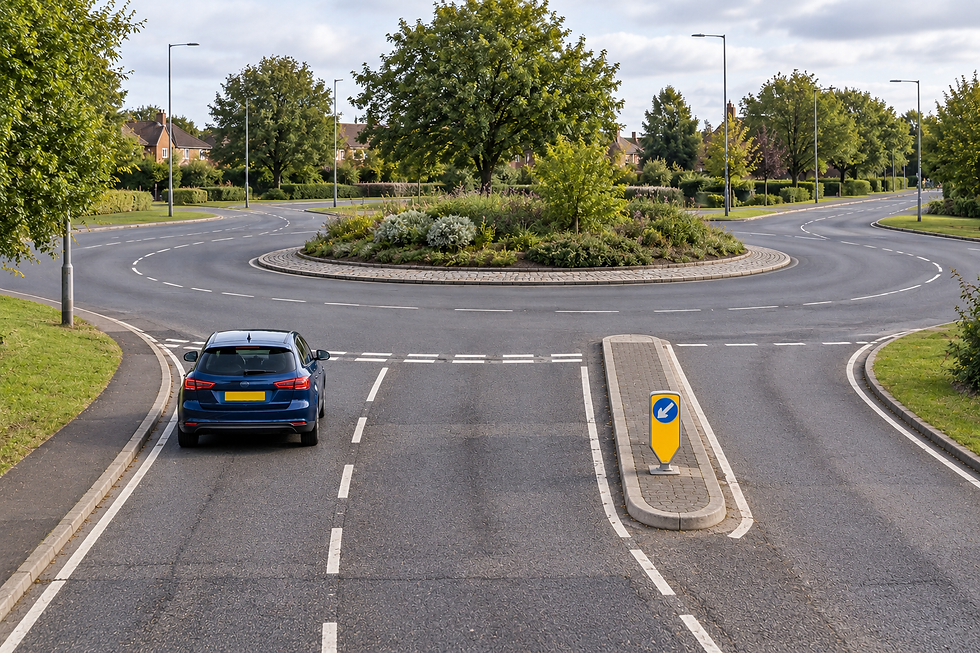
It can guide your first choice on a simple, unmarked roundabout. Imagine you enter at six o’clock and straight ahead is twelve. A left-hand exit before twelve, and often a straight-ahead exit at about twelve, will usually be approached from the left lane. An exit clearly to the right of twelve, or a full circle, will usually be approached from the right lane. This is the common clock-face guide instructors use when introducing lane choice.
The exception is any junction where the signs, lane arrows or layout tell you to do something different. For example, a second exit slightly past twelve might still be marked ahead from the left lane. Follow that marking. If the left lane is marked left only, do not use it to go ahead even if the exit looks close to twelve. At a spiral roundabout, follow the marked lane towards your destination rather than trying to apply a clock-face position to every exit.
The “12 o’clock rule” is not a standalone Highway Code rule. The Highway Code rules on roundabouts say to use the signs and lane markings at the junction. Rule 186 gives the usual left-lane approach for the first exit left, right-lane approach for an exit to the right or a full circle, and the appropriate lane for an intermediate exit, unless signs or markings indicate otherwise. Use the clock to form an initial expectation, then check the actual instructions before choosing your lane.
What changes on a three-lane or spiral roundabout?
A three-lane approach may give each lane a different destination, or it may allow more than one lane towards the same road. Read the overhead or roadside sign and the words and arrows on your lane. The Highway Code rules on roundabouts do not give the middle lane a universal straight-ahead role. Where an entrance has more than three lanes, Rule 186 says to use the most appropriate lane on the approach and through the roundabout.
If you are looking for a three-lane diagram, start with this illustrative approach, then compare it with the markings at the real junction:

Painted arrow in this example | Left approach lane | Middle approach lane | Right approach lane |
Destination shown | Left exit | Ahead exit | Right exit |
What to do | Follow the left-turn lane | Keep within the ahead lane | Follow the right-turn lane and prepare to leave safely |
This is one possible set of lane arrows, not a general rule for all three-lane roundabouts. A real sign might put the same destination in two lanes or send the middle lane to a different exit. Trace your marked lane from the entrance towards its destination before joining; do not move sideways just because the simple example above looks different.
On a spiral layout, painted lane boundaries guide you around and gradually towards an exit. Follow the continuous markings for the destination you chose; do not cut across the spiral because your exit suddenly appears nearby. If the markings are unclear in heavy traffic, reduce speed, leave space and avoid committing to a lane change that is not safe. On complex layouts, reading a destination name early matters more than guessing by exit number.

When do you give way, signal and leave?
At the entrance, normally give priority to traffic approaching from the right unless signs, road markings or traffic lights say otherwise. Check that the car ahead has actually moved before following it. A vehicle signalling left on the roundabout might not leave where you expect, so use its position and movement as well as its indicator when deciding whether the gap is safe.
For a right-hand exit, signal right on approach, keep to the right until you need to change lanes to exit, then signal left after passing the exit before yours. For an intermediate exit, you do not normally signal on approach; signal left at the same point before leaving. Check mirrors and be aware of anyone on your left before altering course. A signal explains your intention; it does not create a safe gap. These Highway Code rules on roundabouts also require particular care around cyclists, who may remain in the left-hand lane while continuing around.
Watch the exit road too. Pedestrians may be crossing it, a long vehicle may straddle lanes, and another driver may be positioned incorrectly. Leave enough room to respond instead of treating the painted line as a guarantee that everyone else will stay in place.
What if you realise you are in the wrong lane?
Stay calm and follow the lane you are in. Take an alternative exit and find a safe route back if the markings lead you away from your destination. Depending on the layout and only if safe, you may be able to continue around to your exit. Do not stop on the roundabout, swerve across another lane or cut across a cyclist to “save” the turn.
For example, you approach in a lane marked left only but want to go straight ahead. If it is too late for a safe and lawful change before the line, take the left exit and reroute. Missing the intended exit is a small inconvenience; creating a conflict between roundabout lanes can have serious consequences.
If this happens repeatedly in lessons, ask your instructor to practise the advance sign and approach arrows, not just the movement around the central island. DVSA’s Ready to Pass? roundabout skills guidance treats observation and positioning as skills to develop before a test.
Do the same lane rules apply to mini-roundabouts?
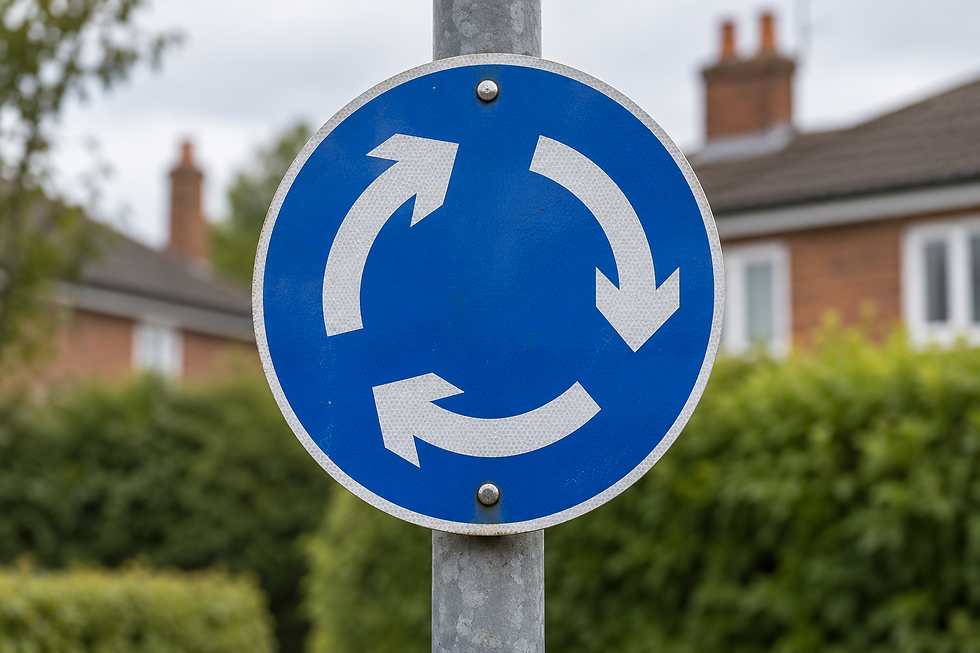
A mini-roundabout gives you much less room and time, so approach at a speed that lets you observe and respond. Follow the normal roundabout approach principles, but do not imagine there are always two marked circulating lanes. The blue circular mini-roundabout sign shows white arrows around a central circle: circulate around the marking and give way to vehicles from your immediate right, unless signs or signals direct otherwise. The actual road markings and layout still matter.
Rule 188 says vehicles must pass around the central marking, except large vehicles physically unable to do so, and advises against U-turns there. The small size means there is less time to signal, but you should still make your intentions clear when you can do so without confusing anyone.
What if there are two mini-roundabouts together?
Treat a double mini-roundabout as two separate junctions. Check for traffic from the right and proceed through the first only when safe. Then reassess the second, give way again as required and choose your path through it. A safe gap at the first does not guarantee a safe gap at the second. This is the practical meaning of Highway Code Rule 189.
Can using the wrong lane lead to a fine or decide fault after a collision?
Is there a fixed “wrong roundabout lane” fine?
There is no automatic fixed fine simply because you chose a lane that was unsuitable for your intended exit. The Highway Code introduction distinguishes legal requirements marked MUST/MUST NOT from advisory should rules: breaking an advisory rule alone does not itself lead to prosecution, although the Code can be used as evidence. What happens in a particular case depends on the signs, markings and driving involved; careless driving or disobeying a mandatory instruction can have separate consequences. The safe response to a late lane-choice mistake is to follow your lane and reroute, not cut across traffic to recover the planned exit.
Who is at fault in a roundabout collision?
There is no automatic answer based only on which car was in the left or right lane. The positions and movements of both vehicles, approach markings, signals, priority, any lane change and the available evidence all matter. Rules 185–187 set out what drivers should watch for, including vehicles positioned incorrectly and cyclists continuing around in the left lane. For an insurance claim, the Financial Ombudsman Service explains that insurers usually decide whether to accept liability under the policy and should base that decision on the evidence. A short keyword search cannot decide responsibility for a real collision.
A practice routine for your next lesson
You can turn the next few roundabouts into a repeatable exercise with your instructor. Before each one, say the destination, sign, arrow and lane out loud. After leaving, ask whether you spotted the markings early enough and whether your signal gave useful information. Try a simple two-lane layout first, then a junction with a dedicated ahead lane, and finally a spiral layout when you are ready. Do not practise a more complex junction without support simply to “get your hours in”.
The question which lane to be in on a roundabout should become a process you can apply to an unfamiliar place, rather than an answer you know only for one test-centre junction. If you need focused practice, find an Asia Driving School instructor and ask about lesson availability in your postcode. You can also compare manual and automatic driving lessons. Instructor availability and local coverage vary.
Frequently asked questions
Which lane should I use to go straight ahead?
If you are deciding which lane to be in on a roundabout when going ahead, check the signs and lane arrows first. If no specific direction is given, the left lane may be appropriate on a simple layout, but going ahead is an intermediate exit and you must choose the lane that suits the actual road. Never use a lane marked left only to go ahead.
Is the second exit always straight ahead?
No. “Second exit” tells you the order of exits, not whether your route lies to the left, ahead or right. Use the sign and road markings to identify the destination and lane.
Should I stop at every roundabout?
Be ready to stop, but you do not have to stop when the entrance is clear and it is safe to proceed. Give priority as directed by signs, markings or lights and keep checking to the right and ahead.
Can a cyclist stay in the left lane while travelling around?
Yes. Rule 186 says cyclists, horse riders and horse-drawn vehicles may stay left when continuing across or around, and drivers must take care not to cut across them. Check carefully before leaving.
What should I do if I miss my exit in a driving test?
Continue safely in your lane and take an alternative route when necessary. Avoid a sudden lane change or unsafe exit. Your instructor can practise this decision with you before test day.
The next time you approach a roundabout, give yourself one simple job: find your destination and read the lane instruction early. That skill, repeated on different layouts, makes roundabout lanes much less of a guessing game.


Comments